
News
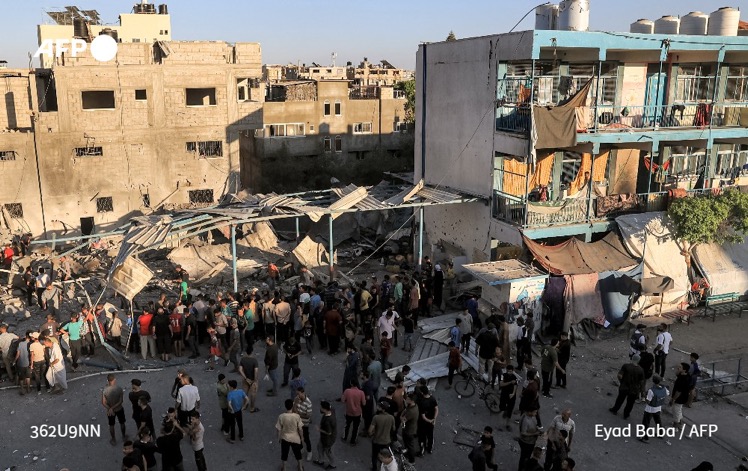
Israeli Airstrike Kills 16 in Gaza School


News
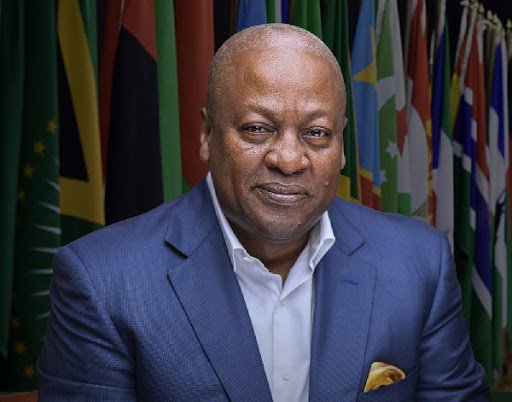
Ghana declares March 20 and 23 as public holidays to mark Eid-Ul-Fitr
Government declares Friday, 20th March and Monday, 23rd March as public holidays for Eid-ul-Fitr celebration.
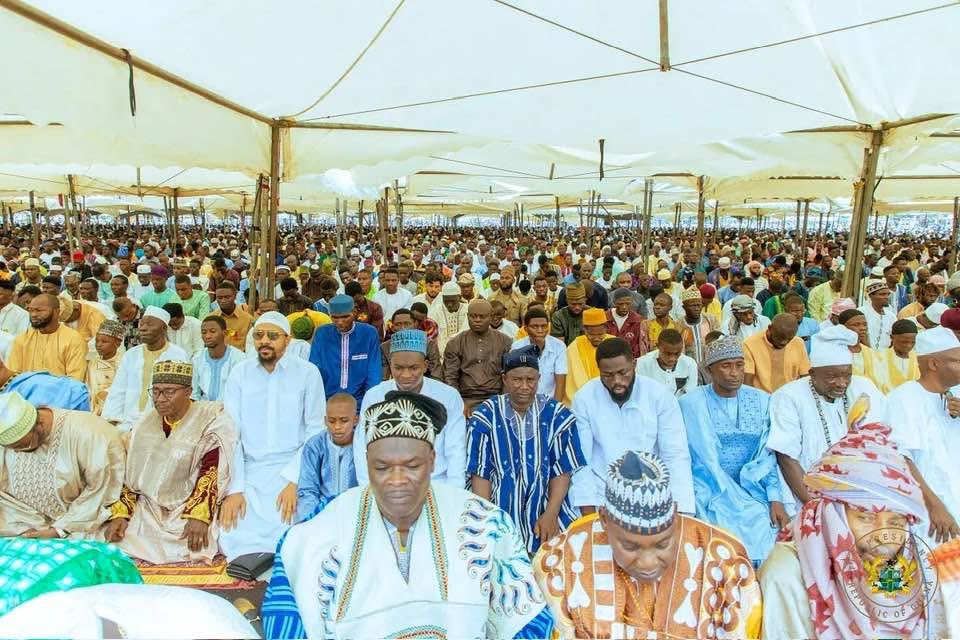
The Government of Ghana has officially declared Friday, March 20, 2026, and Monday, March 23, 2026, as public holidays to mark Eid-ul-Fitr (also known as Eid al-Fitr) and related observances.
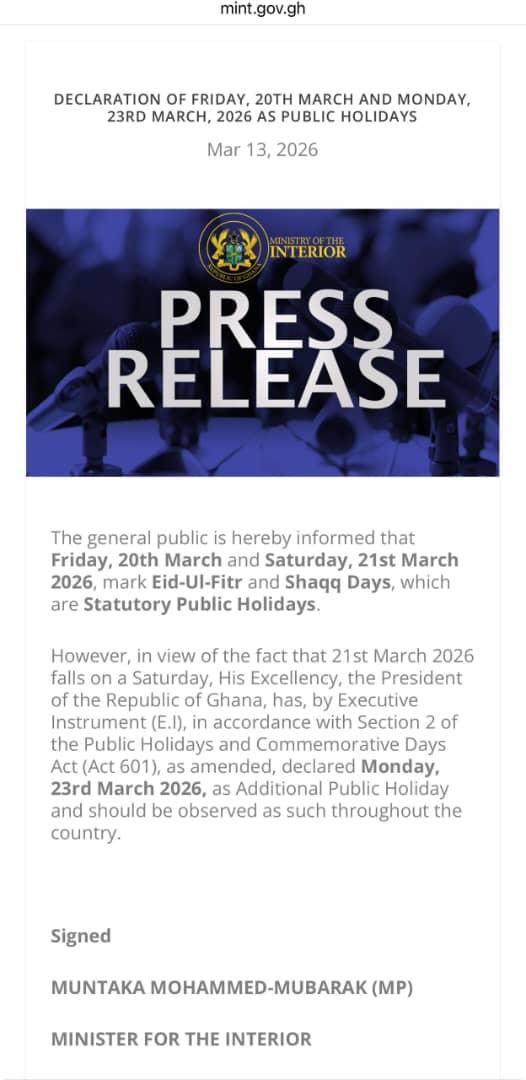
Government declares Friday, 20th March and Monday, 23rd March as public holidays for Eid-ul-Fitr celebration
According to announcements from the Ministry of the Interior (issued on March 13, 2026):
What you need to know
- Friday, March 20, 2026, is a statutory public holiday for Eid-ul-Fitr, marking the end of Ramadan.
- Saturday, March 21, 2026, is recognized as Shaqq Day (the day after Eid-ul-Fitr, a statutory holiday introduced in recent years to allow extended celebration and reflection for the Muslim community).
- Since March 21 falls on a Saturday (a non-working day for many), President John Dramani Mahama issued an Executive Instrument under the Public Holidays and Commemorative Days Act (Act 601, as amended) to declare Monday, March 23, 2026, as an additional public holiday.
This creates a long weekend for celebrations, with schools, government offices, and most businesses closed on those days.
The dates were confirmed following the expected moon sighting for the end of Ramadan, aligning with 1 Shawwal 1447 AH.
Eid Mubarak to all celebrating in Ghana and beyond! Enjoy the festivities, family gatherings, prayers, and special meals.
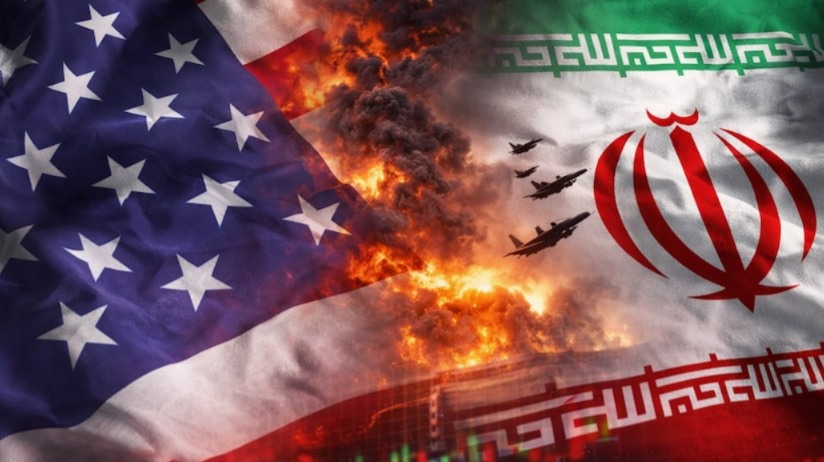
The United States, Israel, and Iran are currently engaged in an active, direct military conflict that began on February 28, 2026. This marks a major escalation from previous shadow wars, proxy conflicts, and limited direct exchanges (including a brief 12-day war in June 2025).
How It Started
-
- On February 28, 2026, the US and Israel launched large-scale joint airstrikes (nearly 900 in the first 12 hours) under US operation names like “Epic Fury.”
-
- Targets included Iranian missile sites, air defenses, nuclear-related facilities, military bases, naval assets, and leadership.
-
- A key early success (from the US/Israeli perspective) was the killing of Iran’s Supreme Leader Ayatollah Ali Khamenei in the opening strikes, along with many other senior officials and Islamic Revolutionary Guard Corps (IRGC) commanders. https://en.wikipedia.org/wiki/Islamic_Revolutionary_Guard_Corps
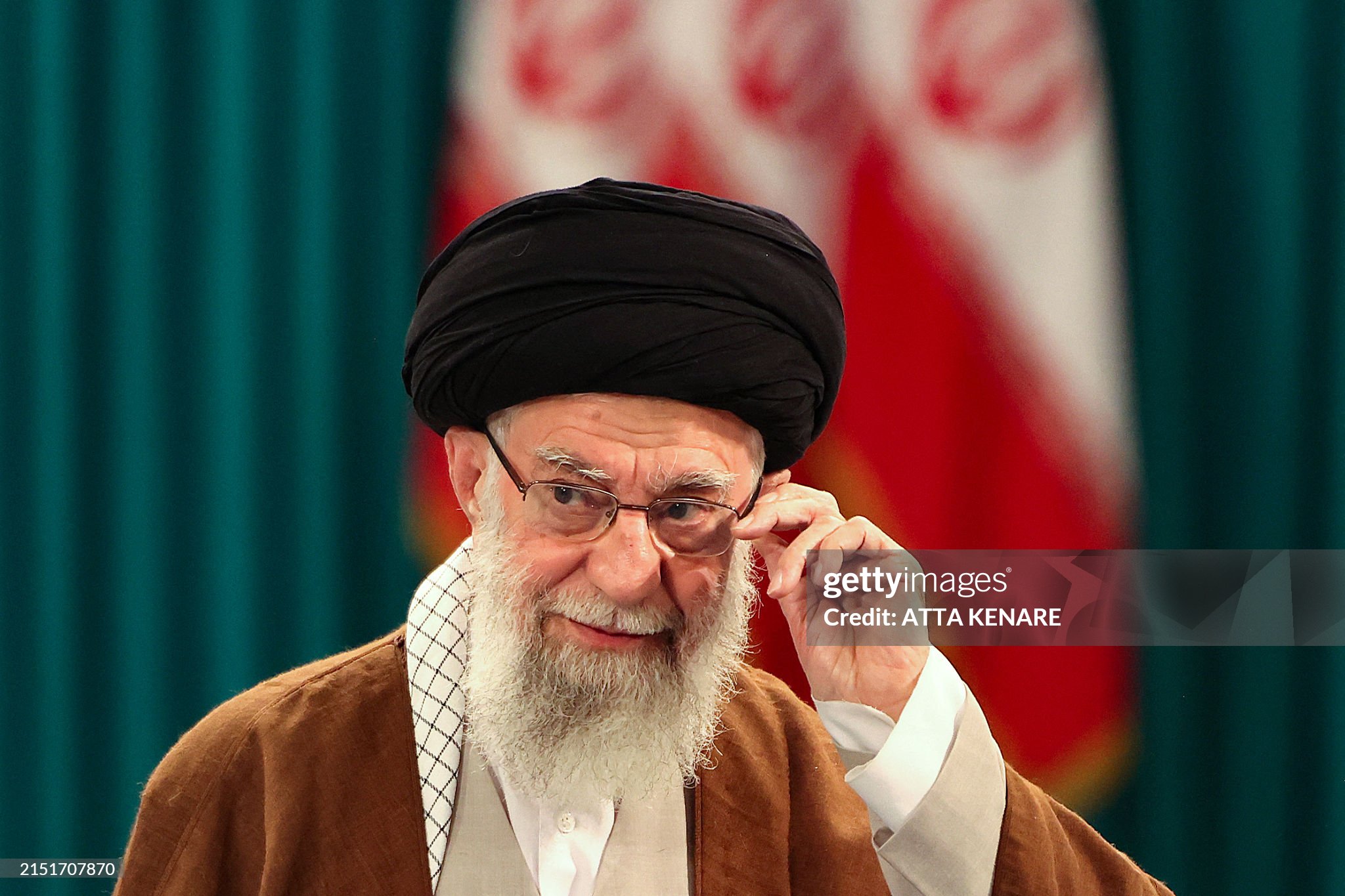
TOPSHOT – Iran’s Supreme Leader Ayatollah Ali Khamenei adjusts his eyeglasses during a press conference after casting his ballot for the parliamentary runoff elections in Tehran on May 10, 2024. (Photo by ATTA KENARE / AFP) (Photo by ATTA KENARE/AFP via Getty Images)
-
- The stated goals include regime change (or at least severely weakening the Islamic Republic), destroying Iran’s ballistic missile program, preventing nuclear weapon development, and neutralizing threats from Iran’s “Axis of Resistance” (proxies like Hezbollah, Houthis, etc.).
This came after failed nuclear negotiations in 2025–2026, years of sanctions, Iran’s weakened position post-2025 exchanges and regional losses, and assessments that military action had a window of opportunity. Current Status (as of March 10, 2026)
-
- The war is in its 11th–12th day (depending on exact counting), with no signs of de-escalation.
-
- US and Israeli strikes continue intensively on Iran, targeting remaining missile infrastructure, leadership, military sites, and naval forces. US Defense Secretary Pete Hegseth described March 10 as potentially the “most intense” day yet, with massive use of fighters, bombers, and munitions.
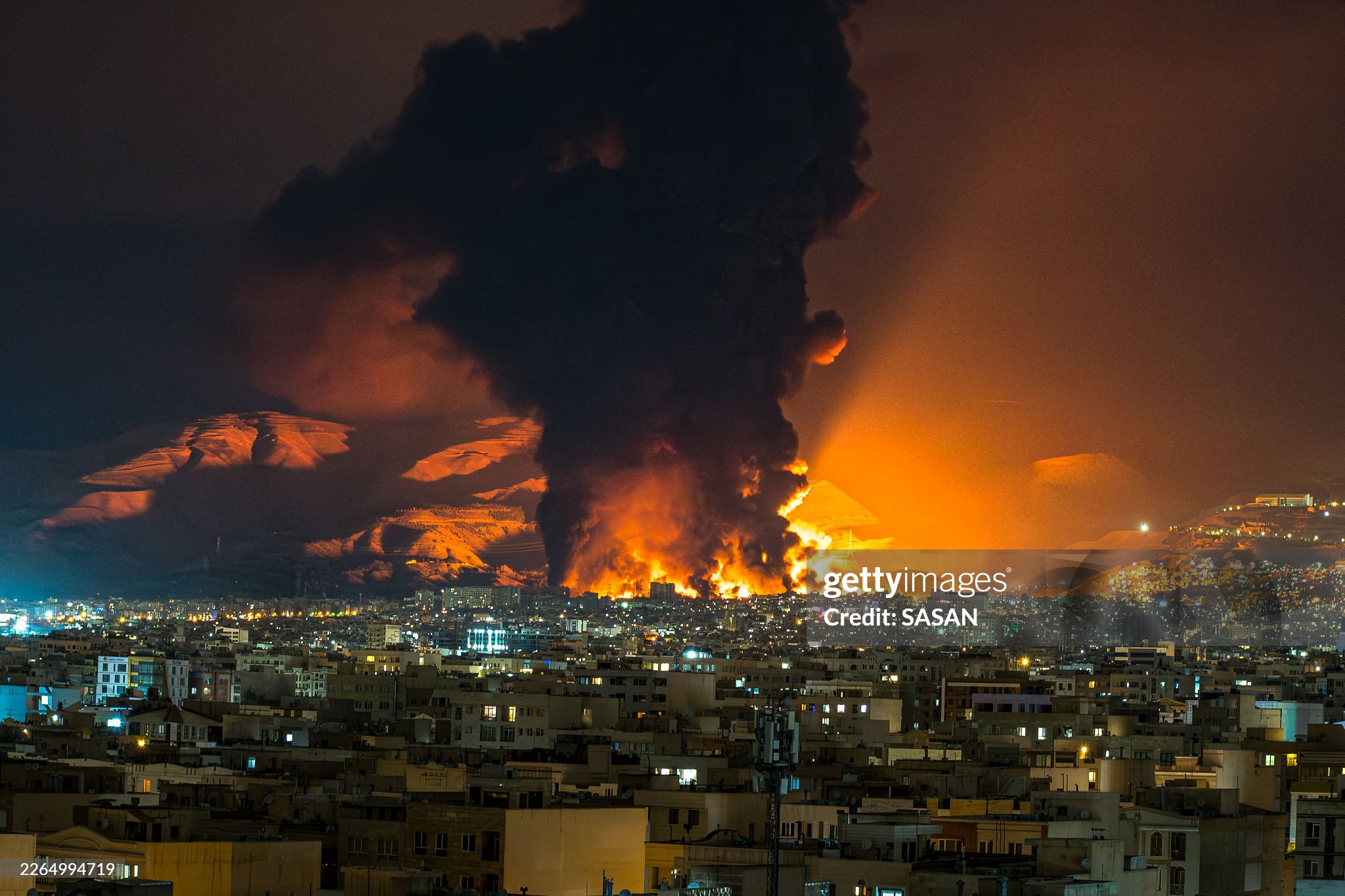
Smoke and flames rise at the site of airstrikes on an oil depot in Tehran on March 7, 2026. The United States and Israel launched strikes against Iran on February 28, prompting Iranian retaliation with missile attacks across the region and intensifying concerns about disruption to global energy and transport. (Photo by Sasan / Middle East Images / AFP via Getty Images)
-
- Iran has launched multiple waves of ballistic missiles and drones at Israel (including barrages hitting central areas like Tel Aviv, killing civilians and causing damage). Recent strikes (March 9–10) killed at least two in Israel and wounded others; Hezbollah (from Lebanon) has also fired rockets, injuring more.
-
- Iran has struck back regionally: attacks toward Gulf states (e.g., UAE/Qatar intercepting missiles), threats to close the Strait of Hormuz (critical oil chokepoint), and hits on shipping/oil infrastructure.
-
- Casualties: Over 1,200 reported killed in Iran (per Iranian sources); civilian deaths on both sides; exact figures are disputed and rising.
-
- Iran’s new leadership: Mojtaba Khamenei (son of the late Supreme Leader) has been named as successor.
Key Impacts So Far
-
- Oil and economy — Benchmark oil prices have surged past $100/barrel (first time since 2022) due to disruption fears. Global markets are volatile.
-
- Regional spillover — Hezbollah attacks from Lebanon; strikes in/around Lebanon; Iranian missiles/drones reaching Gulf states; some incidents affecting neighboring countries (e.g., Jordan, Azerbaijan injuries reported).
-
- Iran’s stance — Iranian officials (IRGC, Foreign Minister) say they’re ready for a prolonged fight (claims of “six-month war” capability), reject negotiations with the US (“bitter experience”), and insist Iran—not the US—will decide when it ends. No ceasefire interest signaled.
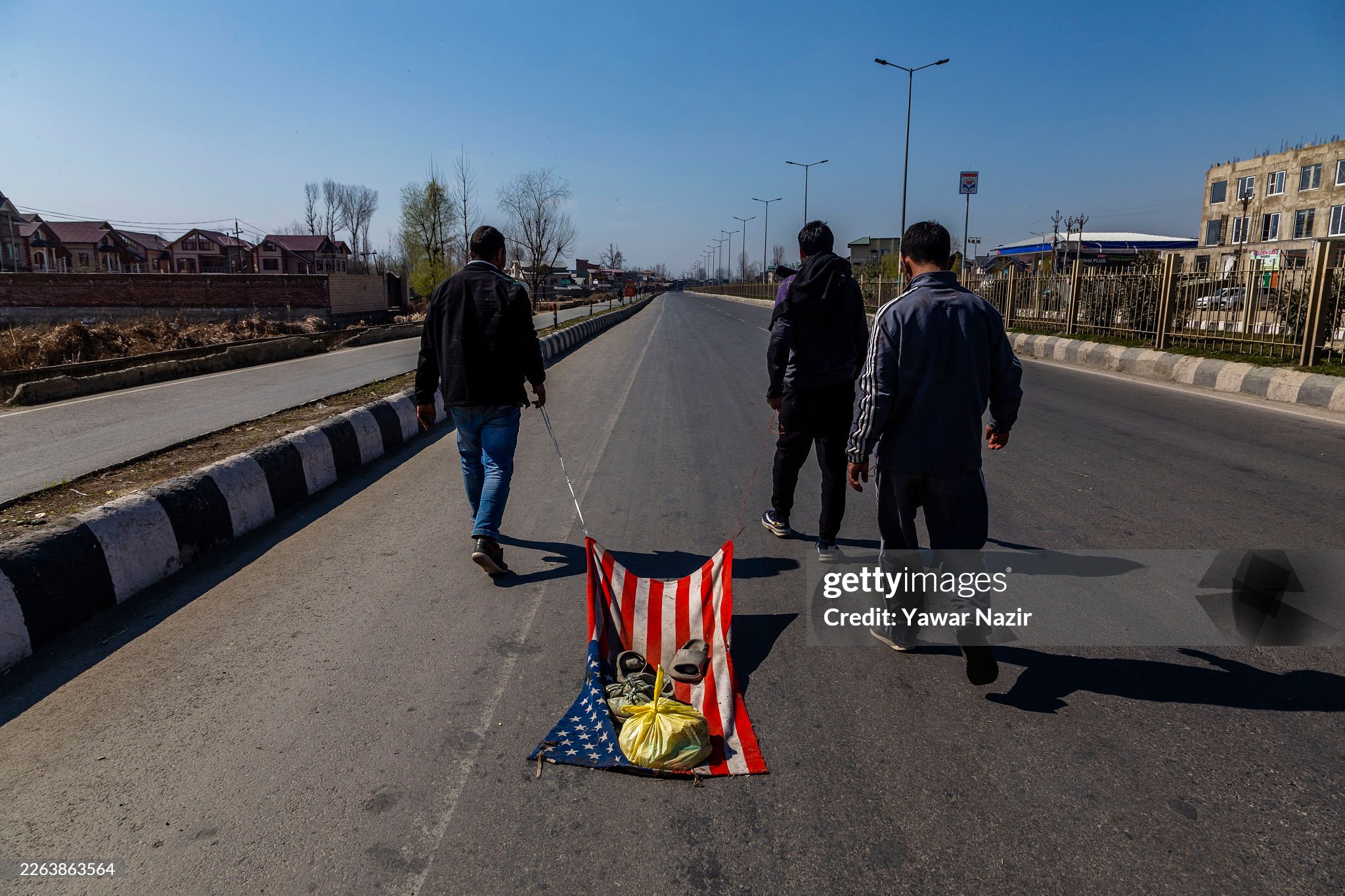
SRINAGAR, INDIA – MARCH 2: Kashirimi Shiite Muslim protester drag the U.S. flag during a protest march against the U.S. and Israel, after Iran’s Supreme Leader Ayatollah Ali Khamenei was killed in Israeli and U.S. airstrikes on March 2, 2026 in Srinagar, India. Security forces in Indian-administered Kashmir sealed off Srinagar’s commercial center on Monday and fired teargas to disperse protests over the killing of Iranian Supreme Leader Ayatollah Ali Khamenei. Authorities imposed restrictions, closed schools, and slowed internet services in the disputed Himalayan region following anti-U.S. and anti-Israel rallies. (Photo by Yawar Nazir/Getty Images)
-
- US/Israel stance — President Trump has said the war will end “very soon” (though not this week), claims Iran was planning regional takeover/domination (including nuclear threats), vows massive response if oil flows are blocked (e.g., “20 times harder”). Officials say operations are ahead of schedule, Iran’s missile/drone capabilities are severely degraded, and Iran “stands alone” and is “badly losing.”
This is not just Israel vs. Iran anymore—it’s a direct US-Israel vs. Iran war with heavy airstrike/missile exchanges. It has upended Middle East stability, rattled global energy markets, and drawn in proxies.
At the moment Russia and China have shown restrained or critical responses without direct intervention. No major ground invasion has occurred (so far it’s air/missile/naval focused), but escalation risks remain high, especially around oil routes or if proxies widen attacks.


Ghana declares March 20 and 23 as public holidays to mark Eid-Ul-Fitr

The Unrest in The Middle East and What You Need to Know; US-Isreal/Iran War

Andre Ayew’s Header Sparks Ghana World Cup Selection Debate


-

 Tech2 years ago
The Introduction Of Meta AI Will Blow Your Mind
-

 Sports2 years ago
Novak Djokovic Slams Disrespectful Wimbledon Crowd
-

 Buzz1 year ago
X Users Celebrate Platform Anniversaries; #MyXAnniversary
-

 Entertainment2 years ago
DJ Ashes GH New Mixtape Dubbed ‘Kinaata Friday Mixtape Vol.4’
-

 Entertainment2 years ago
Kofi Kinaata Unveils ‘Kofi oo Kofi’ EP
-

 Sports2 years ago
The 2nd Edition of Workers Day Workout With Coach Jay
-

 Sports1 year ago
International Football Association Board (IFAB’s) New Rule: Corner Kicks for Goalkeeper Time-Wasting
-

 News2 years ago
KODA And The Glucose-6-phosphate dehydrogenase (G6PD) Deficiency And What You Need To Know By Dr. George Anagli